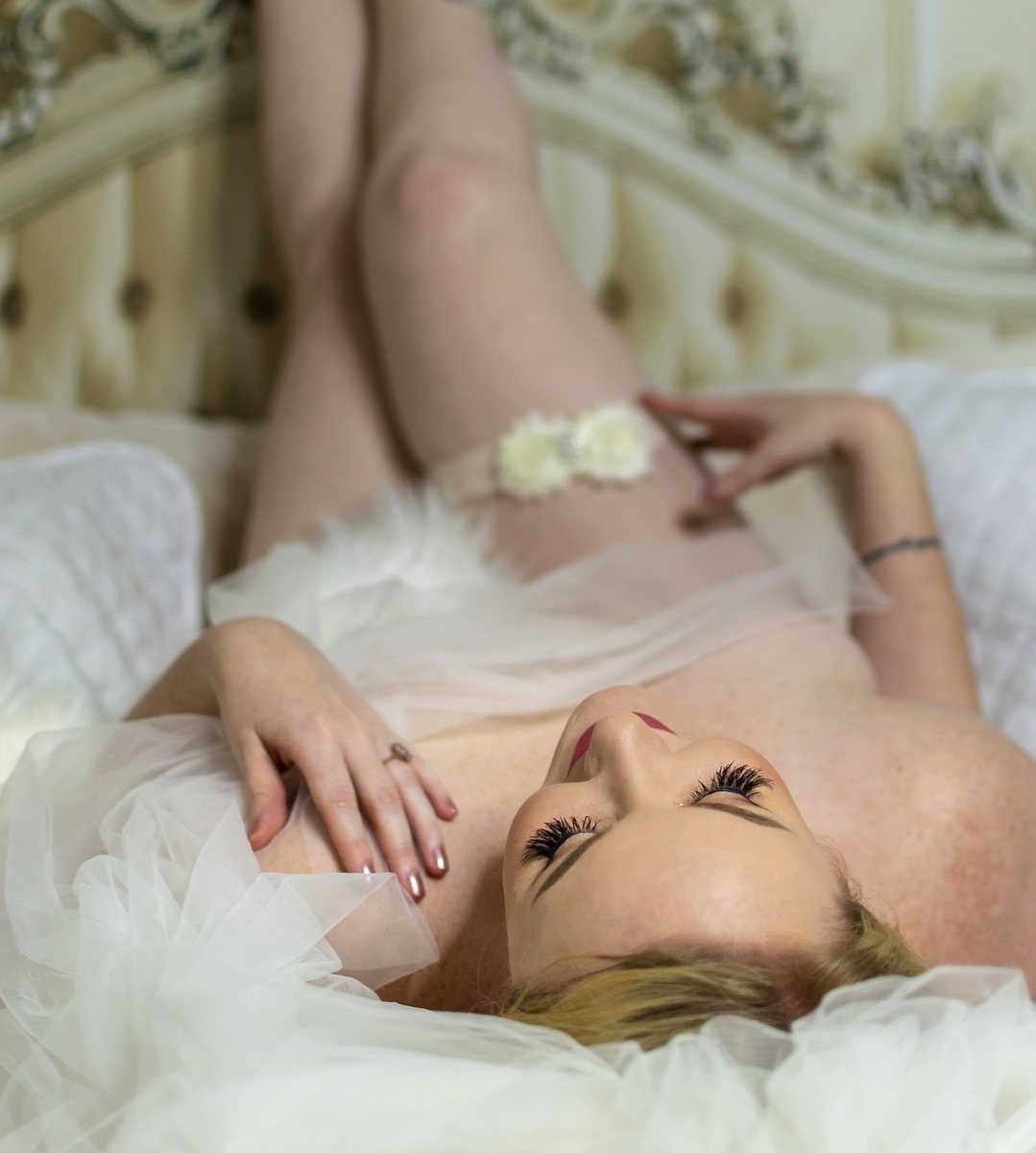
The last thing I did in that apartment — after everything else was packed and gone, after the final cleaning was done, after my whole life had been sorted into a storage unit, my car, and a corner of my acupuncturist's under-house storage — was draw a bath and fill it with four dozen rose petals. The rooms behind me were empty. And I got in, set my camera on a tripod, and made self-portraits with a remote trigger while I lay in the water and the petals.
I hadn't planned it. Earlier that day I'd stumbled on the roses on a clearance rack at the grocery store, and something in me knew immediately what they were for. It was an experiment as much as a ceremony — an inspired idea, improvised in the moment, with no framework behind it and no one watching. Just me, witnessing myself, and the camera in my own hand. The person I'd moved across the country with — twice — was already gone, relocated again for a job in wilderness therapy, a week on and a week off, unavailable. The cleaning fell to me. The closing of the chapter fell to me. The being-alone-at-the-end of it fell to me.
It was the kind of moment that could have just been an ending. Exhausted, scrubbing a place I was about to leave forever, in a town I'd arrived in by a long chain of circumstance — at the close of years in which I had carried a great deal under real pressure, and also chosen to carry it, out of love, for as long as there was something worth giving everything to. Both were true. And now it was over, and I was the one left to close the door.
Instead, I made it a ceremony.
That bathtub was the best one I had ever lived with — a small grace I had noticed and loved the whole time I'd been there. So I gave it the send-off it deserved, and gave myself the send-off I deserved. Four dozen clearance-rack rose petals. Warm water. The camera on its tripod, the trigger in my hand. A marking of a threshold I was crossing whether I wanted to or not.
I didn't have language for what I was doing. I didn't have a plan. I just knew, the way you know things in the body before the mind catches up, that it was necessary — and that the roses had appeared for exactly this.
Something that had been growing in me
I think about that night a lot now, because it shows me something I couldn't see while I was living it. Over the years before it — through that whole long, hard chapter — I had been turning toward ritual and ceremony more and more. It had been growing in me quietly, a deepening instinct to mark things, to hold them with intention, to reach for the image as a way of keeping what was true. That night in the tub was that instinct arriving fully, expressing itself completely, even though I still had no name for it.
A woman alone in an empty apartment, at the end of one of the hardest chapters of her life, who fills the tub with clearance roses and sets up the camera to witness herself — that woman is not just coping. She is witnessing herself. She is refusing to let a significant passage go unmarked. She is insisting, against every reason not to, that this moment of her life deserved beauty and attention and a record.
That instinct — the one that had been growing in me for years — is the seed of everything Sovereign Splendor became.
Why we mark thresholds
Here is what I believe, and what that rose petal bath taught me before I had the words for it:
The body knows the difference between an ending that was witnessed and one that was just survived.
When you move through something significant — a leaving, a loss, the close of a chapter — and you let it pass unmarked, your system files it as one more thing endured. But when you mark it — when you create even a small ceremony, light the candle, draw the bath, make the image, say the words out loud — something different happens. The nervous system registers it. This mattered. This was real. I was here for it. I saw it.
This is why ritual exists in every human culture that has ever lived. Not as decoration. As technology. A way of telling the deepest part of yourself that a crossing has occurred, so that you actually arrive on the other side of it instead of dragging the unfinished ending behind you for years.
I didn't have a teacher when I drew that bath. I had an instinct, and four dozen roses, and a camera, and the stubborn refusal to let my own threshold go unhonored.
You can do this too
You do not need me, or any practitioner, to mark a threshold. The instinct can grow in you — the same way it grew in me, quietly, over years, until one night when I had nothing left I made ceremony anyway.
If you are at the end of something — or the beginning of something — I want to invite you to mark it. However you can. A bath. A candle. A walk. A photograph. A sentence spoken aloud to an empty room. The form matters far less than the act of deciding: this will not pass unwitnessed. I was here. I crossed this.
That is the whole of it, really. The work I do is just this instinct, made deliberate, held with skill, and given the time and beauty and witness it deserves. But the seed is something you already have.
I had it in a nearly empty apartment, in a tub full of clearance roses, as the last act before I closed the door. I didn't fully understand it then. Only years later could I see that it was a seed — the same instinct that would eventually become my entire life's work, showing itself in the dark, before I had any idea what it would grow into. You have that seed too. You may not yet know what it is.